Items
51–100 of 8798
Advanced search
-
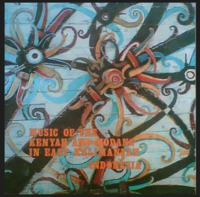
 Ləsɔng undat (gigantic mortar to pound rice) Music of the Kenyah and Modang recorded in 1977 by I Made Bandem, Nicole Revel-Macdonald and Jose Maceda, published with financial assistance of Unesco and Directorate of Culture of Indonesia. SIDE I - Kenyah. A - Music for entertainment, feasts, celebrations
 -
Təwung (long conical drums) Music of the Kenyah and Modang recorded in 1977 by I Made Bandem, Nicole Revel-Macdonald and Jose Maceda, published with financial assistance of Unesco and Directorate of Culture of Indonesia. SIDE I - Kenyah. A - Music for entertainment, feasts, celebrations
-
 Gramophone Company The Gramophone Company was founded in April 1898 by William Barry Owen and Edmund Trevor Lloyd Wynne Williams, commissioned by Emil Berliner, in London. It was one of the earliest record labels (Wikipedia).
 -
Dangan sentara bounga melati ; Terang boulang ; Nina bobo (Three popular songs) Pathé record, Musée de la Parole, Hubert Pernot
-
Conte populaire en langue malaise: Bawang pounti sama bawang mera Pathé record, Musée de la Parole, Hubert Pernot
-
Kecak chorus Appearing in its present form at the beginning of the 1930s, this genre drew from older models, such as the trance-dances as practised in temples. A chorus of men, some forty performers, seated in concentric circles facing towards the centre, where a scene from the Ramayana is played, with the texts declaimed by actors. The chorus itself performs a polyphony of diverse cries and onomatopoeias, wherein the syllables [ke] and [cak] (pronounced "cha") are stylised monkey calls. The result is a varied rhythmic counterpoint, mainly using techniques of hocket, ostinato and off-beat. Synchronisation betwecn the different parts is rigorously directed by one of the members in the chorus, a sort-of conductor whose signals can be clearly heard. There is no place for improvisation, and all the parts, whose number vary during a performance, have been learned by heart.
-
Heyalo song A Heyalo song, by Ulahi and Eyoobo. In Kaluli conception, the two voices do not "follow" one another, but "lift up over" (Dulugu Molab), in a sort of echoing. The Heyalo songs may be performed either during ceremonies or for personal diversion. Composed in the traditional style, for some ceremonies held about 1970, this Heyalo is sung here by two women during a pause from work in the gardens. The text compares some children to doves, flying off, to a distant school, stopping at each village to tell their parents, brothers and sisters : "l won't be coming back".
-
Harmonic melody (insect) Melody on harmonics, by Kabyo (son of) Nuwas, using the buzzing of a beetle (Fut Mwag). The beetle is attached by its legs to a stem, then held in front of the mouth while it attempts to fly away. The insect provides an "instrumental" drone. By modifying the volume of the buccal cavity serving as resonator, the boy selects harmonics to make a melody (an analagous technique to that of the Jew's harp)
-
Individual singing Individual singing called Dit, by Ginto and Kuto. The two girls of eleven freely string together some song sequences, without trying to coordinate their voices. Sung here while weaving a net.
-
Singing with pilipe flute Voice and flute pilipe, by Mabu. In the first iece, the musician sings in falsetto and blows alternately in the pilipé flute, a small bamboo tube producing a single pitch. The melody as sung has five degrees, all below the fundamental frequency of the flute : with three principal degrees separated by about a tone, and two intermediate degrees, the descending melodic contour imitates the intonation of the spoken language. In the second piece (as from O'28), the musician lets out cries at the same time as sudden bursts of breath into the flute, thus imitating with instrument and voice some vocal techniques, partly yodelled, tyically utilised by a number of performers during a ritual. The text of the first piece is made up of metaphorical expressions concerning an unfaithful wife, whom the singer wishes would return to him
-
Men's songs Dshambukware song, performed by Ndukabre (Dshambu is the name of the totemic emblem, in the form of a bird, of a clan).
-
Voice and flute playing Female voice and flute, by Nang Suy. he musician sings and plays alternately on a flute with two holes pierced near the closed extremities of the bamboo, the embouchure being in the centre of the instrument. Vocal and instrumental sounds mingle continuously in this improvisation. Nang Suy manifestly seeks to imitate the sound of the flute by her voice, such that the vocal and instrumental timbres are hard to tell apart. The musician sings and plays for personal pleasure, also at village fêtes. Tran Quang Hai, cf. p.50 of booklet
-
Voices of the Mai Spirits Two men singing each in one tube of bamboo, which act as voice-alterers. The Mai spirits are represented by men in masks who hide the bamboo tubes under their costumes. Always paired, the young initiated men wore such masks during a ceremony, which had practicaîly disappeared by the 1960s. The text mentions the Sepik River and the floating logs that come down it, as well as men with scarifications. » Hugo Zemp, cf. p.48 of booklet
-
Hat cheo theater song Satirical song, of the folk theatre of North Vietnam, hat chèo. Title : Bài hù thuy, "Song of the sorcerer", by Bac Biam Ngu accompanying himself on the trông dê drum, supported by an ensemble of a moon-shaped lute, in ngayêt, a two- string fiddle dan nhi, several drums trong and a small gong. Man's song, nasalised, in a high tessitura, in a syncopated rhythm. The words make couplets of verse of six to eight syllables. Some words or syllables without meaning vary the melodic and rhythmic design.Extract from the piece called Xuy Van (Xuy Vân, the mad one). Gilles Léothaud, cf. p.40 of booklet
-
Mixed Vocal Chorus with Pairs of Pounding Tubes, 3 Malaysian music published by Jeanne Cuisinier in 1950.
-
Mixed Vocal Chorus with Pairs of Pounding Tubes, 2 Malaysian music published by Jeanne Cuisinier in 1950.
-
Mixed Vocal Chorus with Pairs of Pounding Tube, 1 Malaysian music published by Jeanne Cuisinier in 1950.
-
Gamelan Indonesian music record published by Columbia (D 33003)
-
Voice and gamelan Indonesian music record published by Columbia (D 33003)
-
Gamelan Indonesian music record published by Columbia (D 33001)
-
Gamelan Indonesian music record published by Columbia (D 33001)
-
Male chorus and drums Papua New Guinea music (Columbia record)
-
Male chorus and drums Papua New Guinea music (Columbia record)
-
Male chorus and drums Papua New Guinea music (Columbia record)
-
Male chorus and drums Papua New Guinea music (Columbia record)
-
Male chorus and drums Papua New Guinea music (Columbia record)
-
 Columbia Columbia Graphophone Co. Ltd. was one of the earliest gramophone companies in the United Kingdom. Founded in 1917 as an offshoot of the American Columbia Phonograph Company, it became an independent British-owned company in 1922 in a management buy-out after the parent company went into receivership.
 -
A Shan tale [dialecte Shân dialect, Thai language] Voice recording from Myanmar, Linguistic Survey of Burma made by Sir George Grierson, 1917-1919 (Archives de la Parole)
-
The Tale of the King of the town [Taungthu dialect ] Voice recording from Myanmar, Linguistic Survey of Burma made by Sir George Grierson, 1917-1919 (Archives de la Parole)
-
Love of the Homeland [Karen language, Sgaw dialect], 1 Voice recording from Myanmar, Linguistic Survey of Burma made by Sir George Grierson, 1917-1919 (Archives de la Parole)
-
Mya Chay Chin Ma Ngwe, Myaing's group, 2 Vocal recording from Myanmar, Parlophone Label, B.42872 (Germany)
51–100 of 8798