Deprecated: strpos(): Passing null to parameter #1 ($haystack) of type string is deprecated in /var/www/html/themes/JaapKunstFoundation/view/omeka/site/item/show.phtml on line 27
Deprecated: strpos(): Passing null to parameter #1 ($haystack) of type string is deprecated in /var/www/html/themes/JaapKunstFoundation/view/omeka/site/item/show.phtml on line 54
Song of the Neighboring Tribe of the Awins: the Moyans (or Yengons)
- Archivist's Original Title
- Original description
- Time duration
- Acquisition Date
- Time period
- Population
- Place of the cultural origin
- Country Name
- Recording place
- Comment
- Tags, Keywords
- Archivist Category
- Recording context
- Instrument, Original Archivist Data
- Collector
- Name of original Collection
- Collection source citation
- History of ownership
- Holding Institution of Original Materials
- Licensing Institution
- Accessing Institutions
- Copyright Information
- Copyright Notice
- Physical format
- Preservation State of Physical Object
- Original item number
- SEAH Identifier
-
en
Song of the Neighboring Tribe of the Awins: the Moyans (or Yengons)
-
fr
Chant de la tribu voisine des Awins, les Moyans ou Yengons
-
en
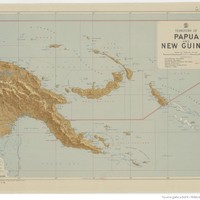
Field recording collected in New Guinea (Region of theof the Fly springs around Mount Kiunga) by Jean Huon de Navrancourt.
-
00:01:42
-
1963
-
1950-1962
-
Moyans - Yengons
-
en
Near Kiunga, near the mountains on the border Indonesia-Papua New Guinea
-
en
The singers, immediate neighbors of the Awins, are the Moyans, also known as the Yengons. They belong to the same linguistic group as another tribe on the other side of the Dutch border: the Moujous (spelling to be verified). Structure of the musical excerpt:
- A: whistled section
- B: vocal part sung by three men. The melody is based on a thematic cell repeated three times, composed of two melodic motifs, “a” and “b.” “a” is itself repeated within the thematic cell (this can be seen as a form of chorus-verse-chorus). This gives the following pattern: a - b - a // a - b - a // a - b - a
- A: reprise of the whistled part
-
fr
Les chanteurs, voisins immédiats des Awins, sont les Moyans ou aussi appelés les Yengons. Ils appartiennent au même groupe linguistique qu'une autre tribu de l'autre côté de la frontière Néerlandaise : les Moujous (orthographe à vérifier). Structure de l'extrait musical :
- A : partie sifflée
- B : partie vocale chantée par trois hommes. La mélodie est basée sur une cellule thématique répétée trois fois, composée de deux motifs mélodiques ''a'' et ''b''. ''a'' est lui-même reprit au sein de la cellule thématique (on peut voir cela comme une forme de refrain-couplet-refrain). Donnant ainsi un schéma : a - b - a // a - b - a // a - b - a
- A : reprise de la partie sifflée
-
en
Awin
-
en
Moyan
-
en
Yengon
-
en
Moujou
-
en
Music (Vocal)
-
en
Field recording
-
en
Singing voice: male, solo and duet
-
en
Whistling
-
J. Huon de Navrancourt, Nouvelle-Guinée, Mont Kiunga (non daté)
-
Copy archived at Musée de l'Homme by Jean Huon de Navrancourt in 1963


-
Public Domain
-
For any use, please contact the CREM-LESC (CNRS, Nanterre University, France): crem.lesc[at]cnrs.fr ; See information at https://archives.crem-cnrs.fr
-
en
Magnetic tape
-
Copy
-
CNRSMH_I_1963_002_001_03
-
SEAH_CNRSMH_I_1963_002_001_03
- Item sets
- Media