Deprecated: strpos(): Passing null to parameter #1 ($haystack) of type string is deprecated in /var/www/html/themes/JaapKunstFoundation/view/omeka/site/item/show.phtml on line 27
Deprecated: strpos(): Passing null to parameter #1 ($haystack) of type string is deprecated in /var/www/html/themes/JaapKunstFoundation/view/omeka/site/item/show.phtml on line 54
(Taman) Gamelan Djoged Bungbung
- Archivist's Original Title
- Original description
- Time duration
- Acquisition Date
- Time period
- Population
- Place of the cultural origin
- Country Name
- Recording place
- Comment
- Tags, Keywords
- Archivist Category
- Recording context
- Instrument, Original Archivist Data
- Collector
- Name of original Collection
- Collection source citation
- External reference
- History of ownership
- Holding Institution of Original Materials
- Licensing Institution
- Accessing Institutions
- Copyright Information
- Copyright Notice
- Physical format
- Preservation State of Physical Object
- Original item number
- SEAH Identifier
-
en
(Taman) Gamelan Djoged Bungbung
-
fr
Gamelan Djoged Bungbung
-
fr
Enregistrement de musique réalisé sur le terrain à Bali (Indonésie) par Louis Berthe entre 1961 et 1963.
-
en
Music recordings made in Bali (Indonesia) by Louis Berthe between 1961 and 1963.
-
00:02:43
-
1971
-
1961-1963
-
Bali
-
en
"The Gamelan Djogéd Bungbung is the accompanying ensemble for the most popular dance nowadays: the Fan Dance, or Djogéd. On the village square, in the evening, a kind of open-air stage is set up, veiled by a theater curtain, or formed of a simple screen, behind which the dancers stand before entering the stage. After a musical opening, they appear in turn in front of the screen; the dancer whose turn it is then performs a fairly long solo in the style of the Legong, then moves towards a point in the audience where, still dancing, she touches with her fan the person she has chosen as partner. Others follow, some better dancers than others, some more or less inventive; this simple entertainment sometimes reaches the art of true ballet, when the dancer falls on an inspired partner. To the delight of the crowd the show can then go on well into the night. The melodic part of the orchestra includes xylophones of bamboo and small flutes with straps. This recording was made in Taman, an ancient village in the south, near the coast of Sanur." Louis Berthe, see back of the cover of the disc "Gamelans of Bali - Music of the Gods, music of Men" (CNRSMH_E_1965_007_001_001_07)
-
fr
"Le Gamelan Djogéd Bungbung est l'orchestre de la danse la plus populaire de nos jours : la Danse à l'Eventail, ou Djogéd. Sur la place du village, le soir, est dressée une sorte de coulisse en plein air, voilée par un rideau de théâtre, ou formée d'un simple écran, derrière lequel se tiennent les danseuses avant d'entrer en scène. Après une ouverture musicale, elles apparaissent à tour de rôle devant l'écran ; la danseuse dont c'est le tour exécute alors un assez long solo dans le style du Légong, puis se dirige vers un point de l'assistance où, toujours dansant, elle touche de son éventail celui ou celle qu'elle a choisi pour partenaire. D'autres succèdent, plus ou moins bons danseurs, plus ou moins inventifs ; ce simple divertissement atteint parfois à l'art du ballet véritable, lorsque la danseuse tombe sur un partenaire inspiré, pour le grand plaisir de la foule le spectacle peut alors se prolonger fort tard dans la nuit. La partie mélodique de l'orchestre comprend des xylophones de bambou et des petites flûtes à bandeau. Le présent enregistrement a été réalisé à Taman, village ancien du sud, près de la côte de Sanur."
Louis Berthe, cf. verso de la pochette du disque "Gamelans de Bali - Musique des Dieux, musique des Hommes" (CNRSMH_E_1965_007_001_001_07)
-
en
ensemble
-
en
dance
-
en
flute
-
en
xylophone
-
en
Music (Instrumental)
-
en
Field recording
-
en
Djoged bungbung
-
en
xylophone
-
en
flute

-
Diversité de la musique Balinaise 1961-1963
-
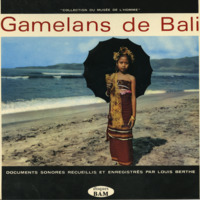
Disque 33rpm :Gamelans de Bali - Musique des dieux, musique des hommes - https://archives.crem-cnrs.fr/archives/collections/CNRSMH_E_1965_007_001/
-
Recording archived at Musée de l’Homme



-
Public Domain
-
For any use, please contact the CREM-LESC (CNRS, Nanterre University, France): crem.lesc[at]cnrs.fr ; See information at https://archives.crem-cnrs.fr
-
en
Magnetic tape
-
Magnetic tape; diameter 18cm; speed 19cm/s; Full Track, Mono
-
CNRSMH_I_2013_038_001_12
-
SEAH_CNRSMH_I_2013_038_001_12
- Item sets
- Media